

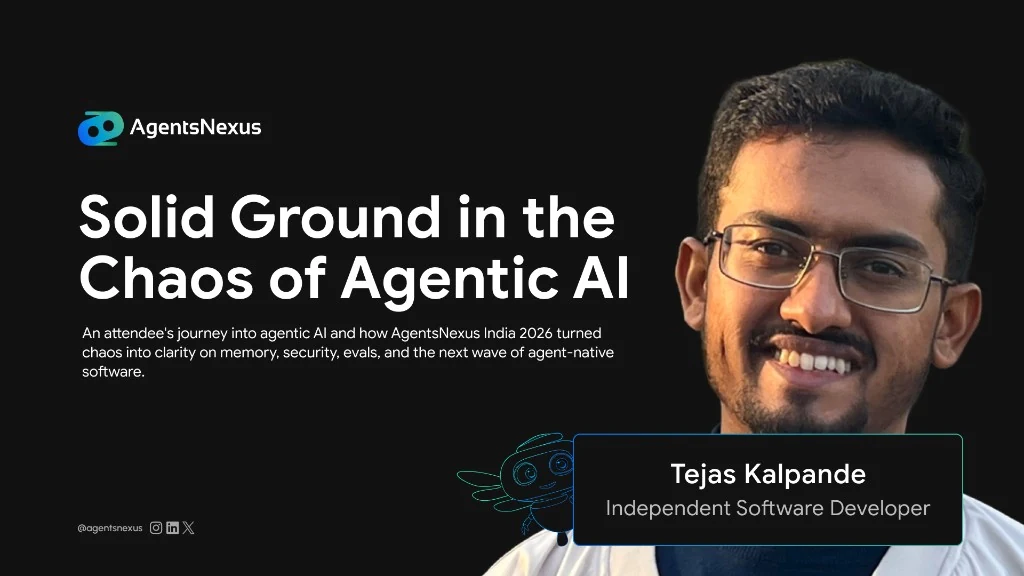
I started my AI and agents journey eight months ago. I was completely new to it, but determined to use AI well in my own work. A month in, OpenClaw dropped, and my jaw dropped right along with it.
Not just an AI that talks. But the one that does. In theory, it could do almost anything for you. Gets better the more you use it and even rewrite its own code. I was floored. It felt like the start of a shift that happens once every few decades, and I decided to be part of it.
AgentsNexus was the perfect checkpoint for that journey. The moment I got to know about it, I knew I had to be there. My journey into the world of agents so far has been chaotic and unpredictable. AgentsNexus made sense of it and gave me solid ground to stand on.
I attend a lot of Tech and AI events around Bengaluru. From the recent events and meetups, I had already sensed where the agentic world was heading: governance, memory, guardrails, evals, observability. Building an agent is easy. But ugly and boring stuff around it is not.
AgentsNexus confirmed it and gave me a far clearer picture of where the world of agents stands today, and where it's headed next. It had something for everyone. It also reminded me how much I still don't know, and how early I am in this.
My key takeaways from the conference
- The model is no longer the bottleneck. AI models are smart enough now. What's hard is everything wrapped around them: memory, security, and testing.
- Memory and context are the problems the industry is currently solving. Real memory means storing what happened, what's true, and what works somewhere permanent, the same way a new hire only becomes useful once someone shows them how decisions actually get made around here, and not by handing them a thicker manual.
- Security is shifting from "keep it out" to "limit the damage." Instead of trying to block every possible attack, the smarter approach is making sure an agent can't do much harm even if something malicious slips through.
- AI agents are turning into customers, not just tools. Businesses may soon need to design their websites and products for agents to use easily, the same way they design for human visitors today.
- Cheaper AI doesn't mean spending less on AI. It means a lot of problems that weren't worth solving before suddenly are.
- Negative instructions in AGENTS.md can degrade agent performance. Too restrictive and serious language affects the agent's effectiveness.
- New SaaS is not for humans but for agents. As they are a new user-class, they will need software and services tailored for them.
The people
Beyond the talks, what stayed with me most was the energy in the room. Conferences can be hit or miss. Some people show up genuinely interested, some look like they'd rather be anywhere else, and the overall mood usually lands somewhere between polite and dull.
AgentsNexus was different. Every person I spoke to, near demo booths, over lunch or in the seat next to mine, was genuinely excited about what they were building or learning. It's the first event where I felt like everyone in the room was pulling in the same direction.
Workshops
I attended two hands-on workshops: agent security by Tejas Ladhani, and WebGPU plus WebMCP by Ashok Vishwakarma. Both were engaging, informative, and refreshingly hands-on.
Agent security, key takeaways
- AI agents pull in tools from outside sources (MCPs), and most people have no idea what those tools actually do and they can inject malicious instructions altering agent behaviour or leaking data.
- You can scan a tool before letting an agent near it, similar to an antivirus scan. Rule-based scans are fast and catch known patterns. AI-based judgment scans catch sneakier stuff, but need a second look before you trust them.
WebGPU and WebMCP, key takeaways
- You can run an AI model locally directly inside your browser using WebLLM.
- WebGPU lets a browser tap straight into your graphics card, something that used to need a native app.
- Currently agents navigate the webpages by parsing the complete DOM, which is unreliable and shaky. WebMCP lets an AI agent discover and use whatever a webpage offers in a systematic manner using the exposed tools. Still a new and experimental standard.
- Ashok showed us the rudimentary but effective guardrails to avoid off-topic questions to the LLM.
All in all, these two days cleared up a lot of my uncertainty around this technology, and they were genuinely delightful. Given how fast this space moves, I think conferences like AgentsNexus should happen more often. A year in AI timelines already feels like ancient history. Following news and hype online is tiring and fickle, conferences like these are grounded in facts, a far steadier place to stand.
About the author
Tejas Kalpande is an Independent Software Developer.
Thank you for joining India’s Agentic AI conference
September 4–5 · Jawaharlal Nehru Planetarium, Bengaluru